1966 Penny vs 1964 and 1967: What Changed?
A 1996 penny often looks ordinary. So do most mid-1960s cents.
When you compare 1964, 1966, and 1967, the real differences are not in the design, but in what? And where policy, production, and preservation.
That is where value begins.
Basic Specifications: Side-by-Side Overview
Before analyzing differences, confirm that the core physical details stayed consistent.
Feature | 1964 | 1966 | 1967 |
Composition | 95% copper, 5% tin & zinc | 95% copper, 5% tin & zinc | 95% copper, 5% tin & zinc |
Weight | 3.11 g | 3.11 g | 3.11 g |
Diameter | 19.05 mm | 19.05 mm | 19.05 mm |
Edge | Plain | Plain | Plain |
Reverse | Lincoln Memorial | Lincoln Memorial | Lincoln Memorial |
Mint Marks | P, D | None used | None used |
As you see: no change in metal, no redesign, no weight adjustment. All three years look almost identical in hand. So if the coins are physically the same, where do differences appear?
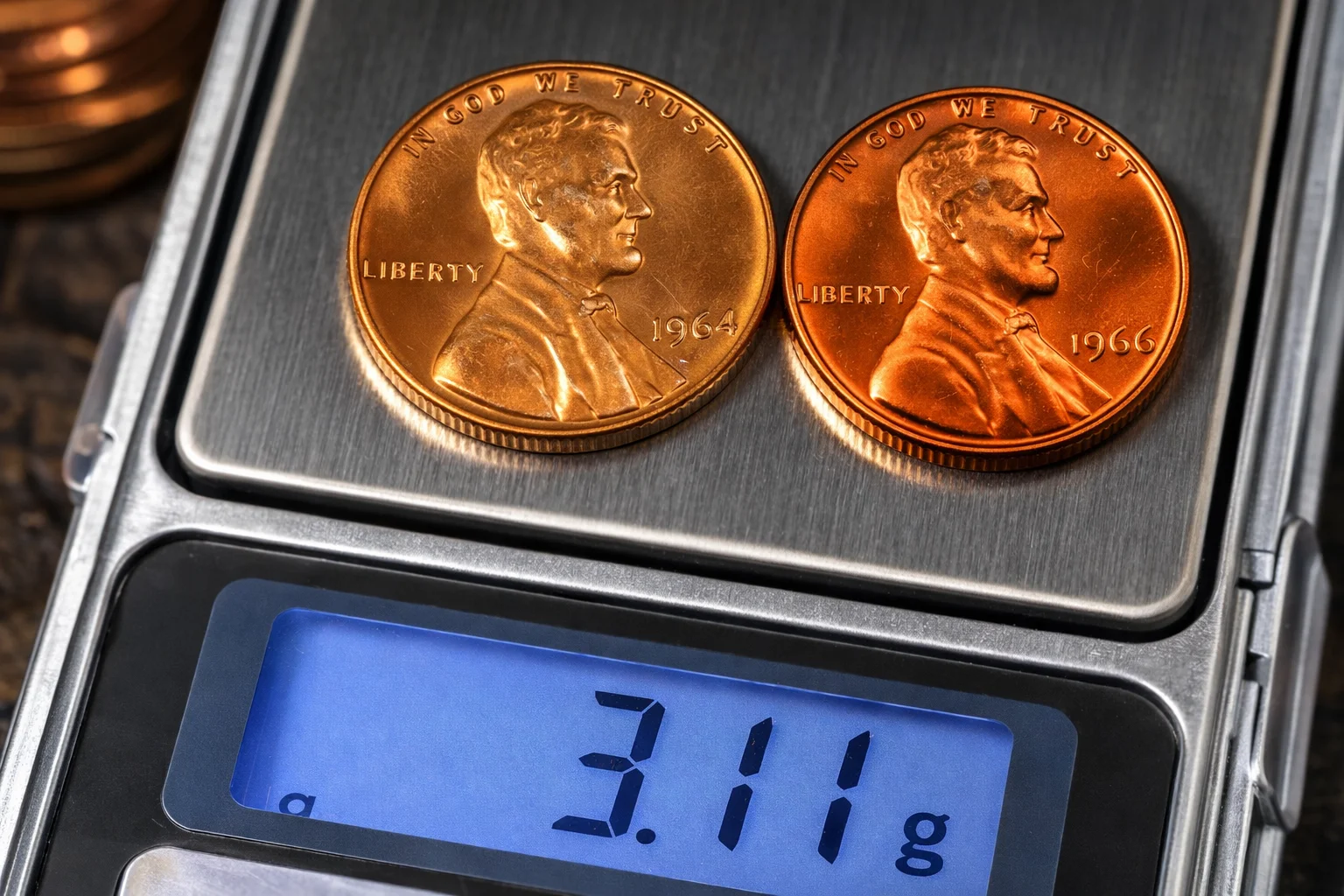
1964: The Last “Traditional” Year
1964 marks the end of a normal mint-mark system before the temporary suspension.
Both Philadelphia and Denver produced cents. Mint marks were visible. Production was extremely high. In fact, the 1964 mintage exceeded previous years significantly.
This happened because of coin shortages. The public hoarded silver coins. The Mint increased output to stabilize circulation.
Many collectors view 1964 as “special” because it was the last year before mint marks disappeared. But high production limits scarcity. Circulated examples remain common.
In Mint State, 1964 can show strong luster and attractive color. High-grade red pieces attract attention, yet the date alone does not create rarity.
1965–1967: Why Mint Marks Disappeared
In 1965, the U.S. Mint removed mint marks from circulating coins. The goal was to reduce hoarding and discourage collectors from separating coins by location.
That policy lasted through 1967.
This decision affects how collectors view 1966 and 1967 cents today. A missing mint mark during those years is not an error. It is standard.
Understanding this prevents one of the most common mistakes: assuming that “no mint mark” means rarity.
1966: The Quiet Middle Year
1966 sits between the heavy output of 1964 and the policy restoration after 1967.
No mint marks were used. Production remained strong but not extreme. The year did not introduce a new design or composition change.
Market perception treats 1966 as neutral. It is not a key date. It is not a transitional metal year. It does not carry a built-in premium.
Most surviving pieces show wear. High-grade red examples exist and are collectible, but availability remains broad.
Because it lacks dramatic features, 1966 often becomes a benchmark year. It reflects typical mid-decade conditions.
1967: The End of the Suspension Period
1967 was the final year without mint marks.
Production continued at high levels. Special Mint Sets (SMS) were issued instead of traditional proof sets during this period. That detail affects half dollars and other denominations more than cents, but the policy context matters.
Collectors sometimes view 1967 as slightly more interesting than 1966 because it represents the end of the mint-mark suspension.
Still, scarcity does not increase sharply. Circulated pieces remain common.
Production and Market Behavior
Large mintages define all three years. None are key dates. None is semi-key.
But survival patterns differ slightly.
1964 had an enormous production and heavy circulation. Many pieces exist, yet high-grade survivors face strong competition in upper grades.
1966 remains balanced. It is widely available in worn condition. Red Mint State coins draw moderate premiums.
1967 benefits slightly from perception as the last year of mint-mark suspension, though this influence is subtle.
Market demand follows a condition for more than a year.
Condition: The Real Divider
When comparing these three dates side by side, grade becomes the deciding factor.
Look at:
Lincoln’s cheek and jaw
Hair above the ear
Coat folds
Memorial columns
Wear produces smooth surfaces. Luster disappears. Details flatten.
Mint State pieces retain texture and reflective surfaces. High points stay sharp.
An MS65 red example of any of these years can trade several times above a circulated coin. The date rarely explains that gap.
Small differences in preservation matter more than the calendar year.
Copper Color: BN, RB, RD
Copper reacts to air. Over time, it darkens. Collectors classify uncirculated copper coins into three color groups:
Brown (BN) – Fully toned. No original red remains.
Red Brown (RB) – Partially original red with brown toning.
Red (RD) – Strong, original red across most surfaces.
Color premiums can exceed date premiums. But remember, it applies only to the original color. Cleaning destroys natural hue and value. Experienced buyers recognize altered copper quickly. Original surfaces carry more weight than brightness.
How to Compare Coins Practically
When evaluating these three years:
Confirm weight and size.
Check for original luster.
Examine color classification.
Inspect for visible mint errors.
Compare grade levels.
A tool like Coin ID Scanner can help confirm year, composition, and design details. It organizes coins digitally and provides technical data for reference. It supports identification but does not replace grading skills.
Surface preservation still requires direct inspection.

Conclusion
What changed between 1964, 1966, and 1967?
Mint marks disappeared for two of those years.
Production remained high.
Design and metal stayed constant.
Market value depended on grade and color.
If all three are circulated, none carry meaningful premiums. Spending them makes little difference. If one shows a strong red color and minimal marks, keep that example regardless of year. If one displays exceptional luster or a higher grade, it becomes more desirable.
From a collector’s standpoint, building a high-grade set may justify keeping all three in red Mint State condition. From an investment standpoint, none are rare enough to create automatic upside.

The Importance of Indexing in SQL Server for Web Developers
In the world of web development, speed and efficiency are key components to the success of a website. One crucial aspect of optimizing database performance is through the proper use of indexing in SQL

Mastering SQL: Essential Techniques for Efficient Data Management
Discover how to master SQL with our comprehensive guide on essential techniques for efficient data management. Learn about basic commands, advanced queries, best practices, and more to optimize your d

What Are the Best Resources for Practicing Advanced SQL Techniques?
Discover the best resources for practicing advanced SQL techniques, including online platforms, books, interactive tools, and community forums. Elevate your SQL skills with expert-recommended courses,
Our Partners:
© Copyright 2026. DataLinker